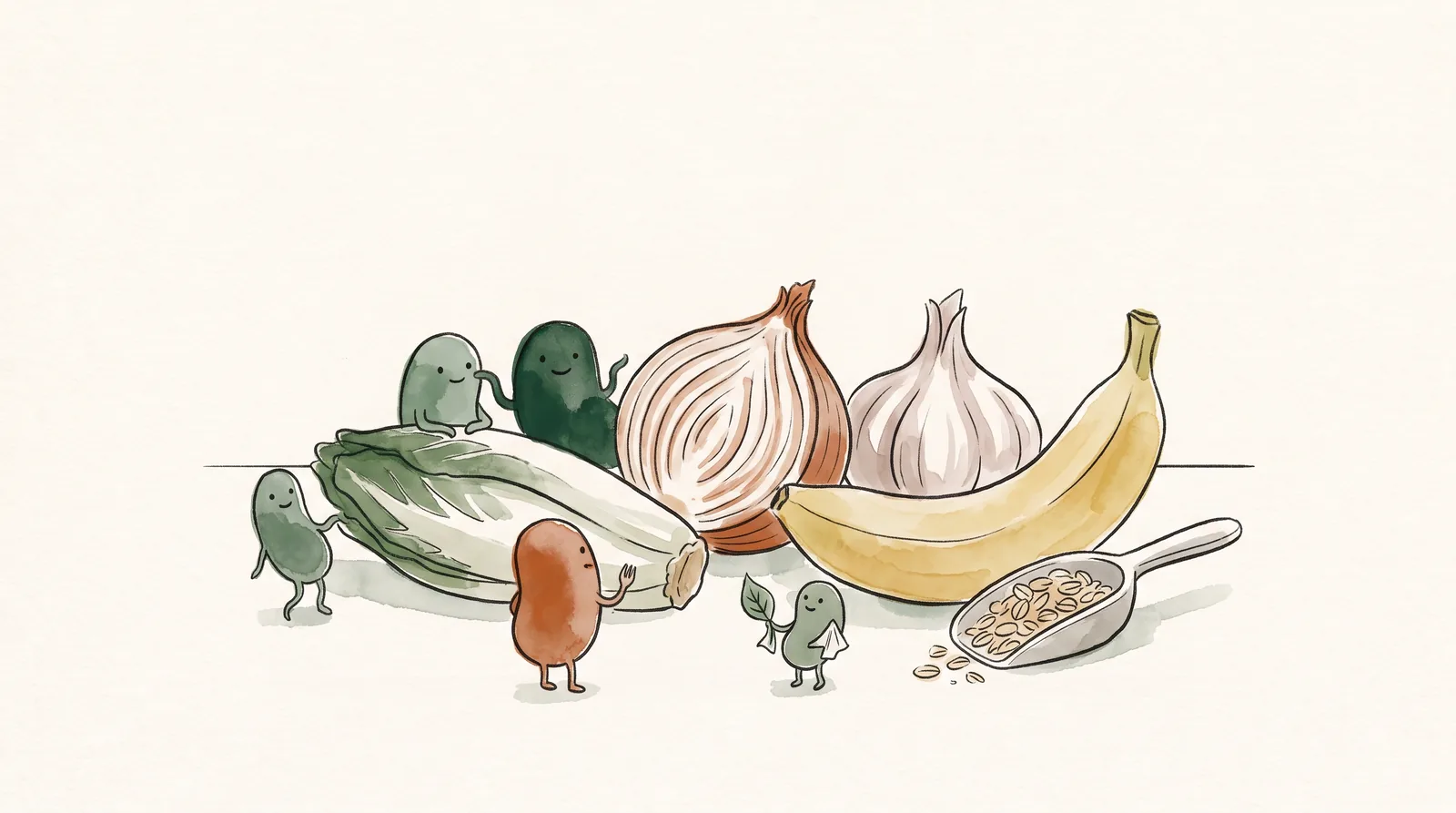
Prebiotics: the food that feeds your good bacteria
Probiotics are live bacteria. Prebiotics are the food for them: fibres that you cannot digest yourself, but that the bacteria in the large intestine can.
The official definition from the scientific organisation ISAPP reads: "a substrate that is selectively utilized by host microorganisms conferring a health benefit" [1]. The word selectively is important: it must be specific, beneficial bacteria that benefit from it, not just all of them.
The most important fibre types
| Fibre | Found in, e.g. | What the research shows |
|---|---|---|
| Inulin | Chicory root, Jerusalem artichokes, onions, leeks, garlic | Increases bifidobacteria, but often causes wind and bloating |
| FOS (fructo-oligosaccharides) | Onions, bananas, asparagus and as supplements | Increases bifidobacteria from as little as 2.5 g a day [2] |
| GOS (galacto-oligosaccharides) | Beans, lentils, chickpeas | Low doses are better tolerated than inulin by people with IBS [3] |
| Resistant starch | Cooled potatoes, rice and pasta, green bananas, oats | Can increase the production of butyric acid (butyrate), but varies a lot between people [4] |
| PHGG (partially hydrolysed guar gum) | Supplements | The best-tolerated fibre in IBS trials [5] |
What happens in the gut?
When the bacteria ferment the fibres, short-chain fatty acids are formed, mainly acetate, propionate and butyric acid (butyrate). Butyrate is the preferred fuel for the cells in the lining of the large intestine.
But this is where it gets interesting: how much butyrate you get from a fibre depends on which bacteria you already have.
In a trial with 174 young adults, the participants were given resistant potato starch, resistant corn starch or inulin for two weeks. Only the potato starch increased butyrate on average, and most in those in whom specific butyrate-producing bacteria grew [4].
A pooled analysis of 64 fibre trials in healthy adults found that fibre increased bifidobacteria and lactic acid bacteria, but not the diversity of the gut bacteria as a whole [6]. Researchers saw the same in the Stanford study, where a high-fibre diet over several weeks did not increase diversity, while fermented foods did (read more in our guide to fermentation) [7].
Why fibre is still a good idea
Even though the effect on the gut bacteria varies, fibre intake itself is one of the best-documented pieces of dietary advice. A large review in The Lancet of 185 population studies and 58 trials found that those who ate the most fibre had a 15–30% lower risk of dying from cardiovascular disease and of getting type 2 diabetes and bowel cancer than those who ate the least. The biggest benefit was seen at 25–29 g of fibre a day [8].
This is population data and shows associations, but it all points the same way.
Do you have a sensitive stomach?
Here it is important to know that many prebiotic fibres are also FODMAPs: carbohydrates that can cause wind, pain and bloating in people with irritable bowel syndrome (IBS).
- A meta-analysis of 11 trials with 729 patients with IBS and similar bowel problems found no overall benefit of prebiotics on pain, bloating or quality of life. Inulin made wind worse. Doses of at most 6 g a day and types other than inulin did better [9].
- PHGG at 6 g a day for 12 weeks relieved bloating better than placebo in 108 IBS patients, without notable side effects [5].
- GOS at a low dose (3.5 g a day) improved wind and bloating in a trial with 44 IBS patients [3].
- In general, soluble fibres (e.g. psyllium/ispaghula) seem to help with IBS, while bran does not [10].
In a controlled trial, a low-FODMAP diet halved the symptom score in IBS patients compared with a typical diet [11]. But it should ideally be planned with a dietitian and not be permanent, because it also cuts down on food for the good bacteria.
How to get started
- Start low and go slow. Increase your fibre intake over a few weeks so your gut can get used to it.
- Think food before supplements. Vegetables, pulses, wholegrains, nuts and fruit provide many different fibre types at once.
- Try cooled potatoes, rice or pasta, because cooling increases the content of resistant starch.
- Drink enough water when you eat more fibre.
- If you have IBS, choose gentle fibres such as PHGG or psyllium over inulin and chicory fibre, and talk to your doctor or a dietitian.
Sources
- Gibson GR et al. The ISAPP consensus statement on the definition and scope of prebiotics. Nat Rev Gastroenterol Hepatol. 2017. PMID 28611480
- Bouhnik Y et al. The capacity of short-chain fructo-oligosaccharides to stimulate faecal bifidobacteria: a dose-response relationship study in healthy humans. Nutr J. 2006. PMID 16569219
- Silk DBA et al. Clinical trial: the effects of a trans-galactooligosaccharide prebiotic on faecal microbiota and symptoms in irritable bowel syndrome. Aliment Pharmacol Ther. 2009. PMID 19053980
- Baxter NT et al. Dynamics of Human Gut Microbiota and Short-Chain Fatty Acids in Response to Dietary Interventions with Three Fermentable Fibers. mBio. 2019. PMID 30696735
- Niv E et al. Randomized clinical study: Partially hydrolyzed guar gum (PHGG) versus placebo in the treatment of patients with irritable bowel syndrome. Nutr Metab. 2016. PMID 26855665
- So D et al. Dietary fiber intervention on gut microbiota composition in healthy adults: a systematic review and meta-analysis. Am J Clin Nutr. 2018. PMID 29757343
- Wastyk HC et al. Gut-microbiota-targeted diets modulate human immune status. Cell. 2021. PMID 34256014
- Reynolds A et al. Carbohydrate quality and human health: a series of systematic reviews and meta-analyses. Lancet. 2019. PMID 30638909
- Wilson B et al. Prebiotics in irritable bowel syndrome and other functional bowel disorders in adults: a systematic review and meta-analysis of randomized controlled trials. Am J Clin Nutr. 2019. PMID 30949662
- Moayyedi P et al. The effect of fiber supplementation on irritable bowel syndrome: a systematic review and meta-analysis. Am J Gastroenterol. 2014. PMID 25070054
- Halmos EP et al. A diet low in FODMAPs reduces symptoms of irritable bowel syndrome. Gastroenterology. 2014. PMID 24076059
This article is general information and not medical advice.