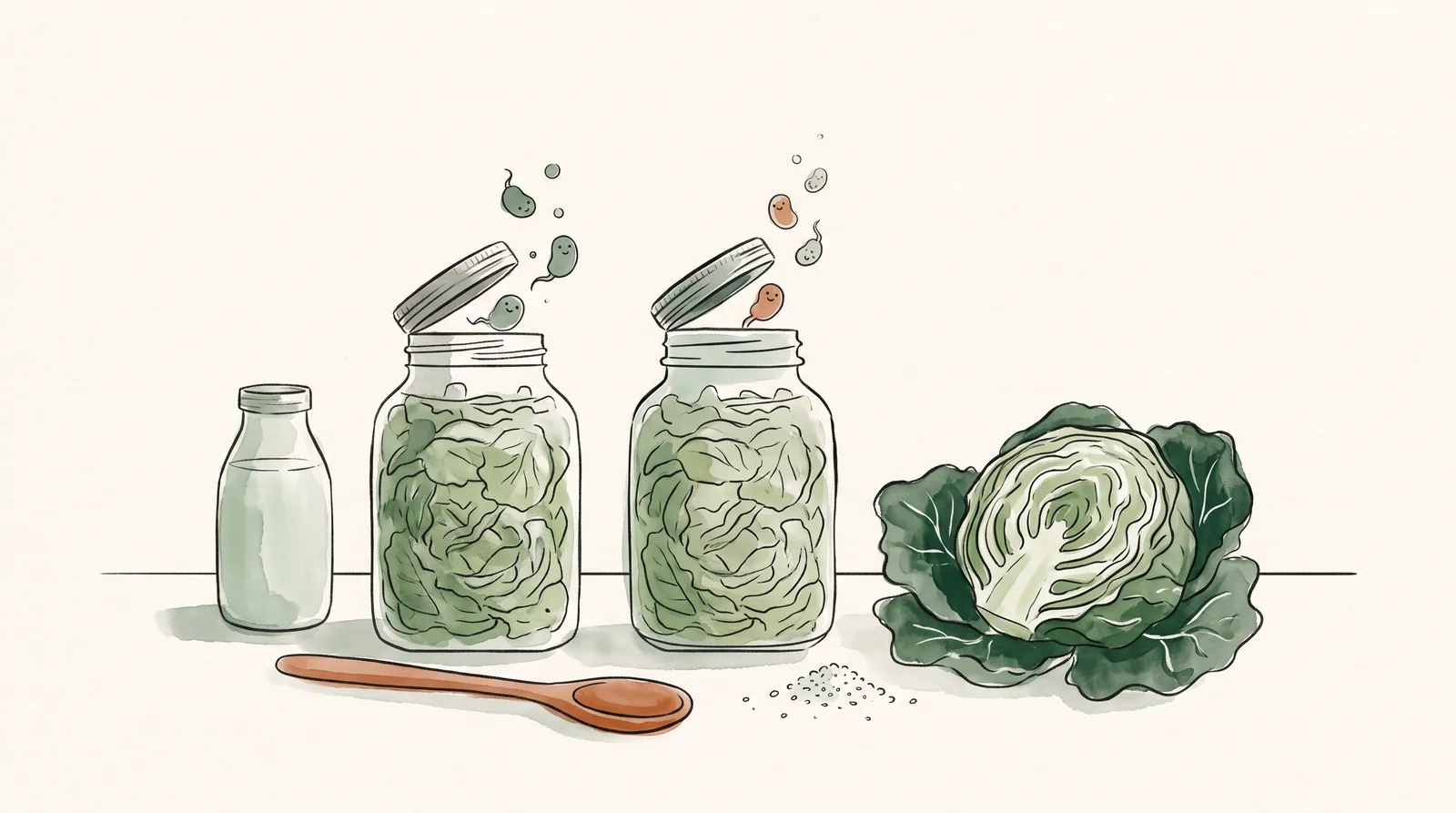
Easy home fermentation: Everyday sauerkraut and kefir
Fermentation is one of the oldest ways of preserving food. Today sauerkraut, kimchi and kefir have become popular again, not least because researchers have started to take an interest in what they do to the bacteria in your gut.
Here you first get an honest look at the research, then two easy recipes and the safety rules that make the difference.
What does the research say?
The most talked-about study comes from Stanford University. For 10 weeks, 36 healthy adults ate either a diet with lots of fermented foods or a diet high in fibre. The fermented food group went from less than one to about six servings a day: yoghurt, kefir, sauerkraut, kimchi, kombucha and vegetable brine [1].
The result:
- The diversity of bacteria in the gut rose gradually in the fermented group.
- 19 out of 93 inflammation markers measured in the blood fell.
- Interestingly, the new bacteria mostly did not come from the food itself. The food seems to change the environment in the gut more than it "plants" new bacteria.
It is a small study, and diversity and blood markers are not the same as getting well or avoiding disease. But it is one of the best-conducted trials in the field.
For individual foods, the evidence is thinner:
- Kefir: A systematic review of 16 trials found only "very limited" evidence of health effects, and many of the trials had methodological problems [2].
- Sauerkraut: In a small Danish-Norwegian pilot trial with 34 IBS patients, both groups improved. That was true both for those who ate ordinary sauerkraut and for those who ate pasteurised sauerkraut without live bacteria. The researchers therefore think that the fibre in the cabbage may play a bigger role than the bacteria [3].
And remember: fermented food is not automatically a "probiotic". That requires a specific, documented microorganism to have shown an effect [4].
Are there live bacteria in homemade sauerkraut?
Yes, usually plenty. A French study of 75 homemade fermented vegetables found up to about 500 million lactic acid bacteria per gram. The number fell the older the jar was, and the highest numbers were in ferments under about 100 days old [5]. Sauerkraut in tins or jars from the supermarket is often heat-treated and then contains no live cultures [6].
Recipe 1: Classic sauerkraut
You will need:
- 1 kg white cabbage (weighed after removing the outer leaves and core)
- 20 g salt (2% of the cabbage's weight), without iodine or anti-caking agent
- Optional: 1 tsp caraway seeds or juniper berries
- A clean jar with a lid (about 1 litre) and a small weight, e.g. a smaller jar filled with water
Method:
- Shred the cabbage finely. Save a couple of whole outer leaves.
- Weigh the cabbage and measure out exactly 2% salt. Mix and massage the cabbage with your hands for 5–10 minutes, until plenty of juice comes out.
- Pack the cabbage firmly into the jar, a little at a time, so the juice rises.
- Lay an outer leaf on top and press it down with the weight. All the cabbage must be covered by brine.
- Put the lid on loosely (so gas can escape) and leave the jar at room temperature, ideally 18–22 °C, on a plate.
- Taste it after at least 2 weeks. When it tastes sour and fresh, put it in the fridge.
Recipe 2: Milk kefir with kefir grains
You will need:
- 1 tbsp kefir grains (from friends, health food shops or online)
- 250–500 ml whole or semi-skimmed milk
- A clean jar and a plastic sieve
Method:
- Put the grains in the jar and pour the milk over them.
- Cover with a piece of kitchen paper and an elastic band.
- Leave it at room temperature for about 24 hours, until the milk has thickened and tastes sour.
- Strain off the grains and start again with fresh milk. The kefir keeps for a couple of days in the fridge.
Safety: the rules that matter
Lactic acid fermentation is a safe method as long as the acid has time to form. It is the acid, not the salt, that protects.
- Use 2–2.5% salt. That is the standard for sauerkraut, and too little salt gives softer cabbage and off-flavours [7].
- Keep everything under the brine. Air causes mould.
- Give it time. In an experiment where researchers deliberately added Listeria and E. coli to sauerkraut, the bacteria were gone after 15 days in shredded cabbage, but survived longer in whole heads of cabbage [8]. A Belgian study recommends fast acidification to pH below 4.4 and at least 14 days of fermentation [9]. Cheap pH strips from online shops make it easy to check.
- Throw it out if it does not turn sour, smells rotten or has mould in the brine.
- Never keep garlic or vegetables in oil at room temperature. Oil shuts out oxygen, and without acid the botulism bacterium can grow. Garlic in oil has caused botulism both in the USA and in Denmark [10][11]. Never use an "oil cap" on your ferment.
- Sensitive to histamine? Fermented vegetables can contain varying and sometimes high amounts of histamine [12]. If you react to red wine or aged cheese, start carefully.
If you are pregnant, have a weakened immune system or are seriously ill, talk to your doctor before you start eating unpasteurised fermented foods.
Sources
- Wastyk HC et al. Gut-microbiota-targeted diets modulate human immune status. Cell. 2021. PMID 34256014
- Kairey L et al. The effects of kefir consumption on human health: a systematic review of randomized controlled trials. Nutr Rev. 2023. PMID 35913411
- Nielsen ES et al. Lacto-fermented sauerkraut improves symptoms in IBS patients independent of product pasteurisation – a pilot study. Food Funct. 2018. PMID 30256365
- Marco ML et al. The ISAPP consensus statement on fermented foods. Nat Rev Gastroenterol Hepatol. 2021. PMID 33398112
- Thierry A et al. Microbial communities of a variety of 75 homemade fermented vegetables. Front Microbiol. 2023. PMID 38163080
- Rezac S et al. Fermented Foods as a Dietary Source of Live Organisms. Front Microbiol. 2018. PMID 30197628
- Johanningsmeier S et al. Effects of Leuconostoc mesenteroides starter culture on fermentation of cabbage with reduced salt concentrations. J Food Sci. 2007. PMID 17995739
- Niksic M et al. Survival of Listeria monocytogenes and Escherichia coli O157:H7 during sauerkraut fermentation. J Food Prot. 2005. PMID 16013372
- Vermeersch M et al. Microbiological survey of spontaneous vegetable fermentations: A food safety perspective. Int J Food Microbiol. 2026. PMID 41330088
- Morse DL et al. Garlic-in-oil associated botulism: episode leads to product modification. Am J Public Health. 1990. PMID 2240308
- Lohse N, Kraghede PG, Mølbak K. Botulisme hos en 38-årig mand efter indtagelse af hvidløg i chiliolie. Ugeskr Laeger. 2003. PMID 12926199
- Montanari C et al. Occurrence and control of biogenic amines in plant-based fermented foods. Crit Rev Food Sci Nutr. 2026. PMID 42568231
This article is general information and not medical advice.