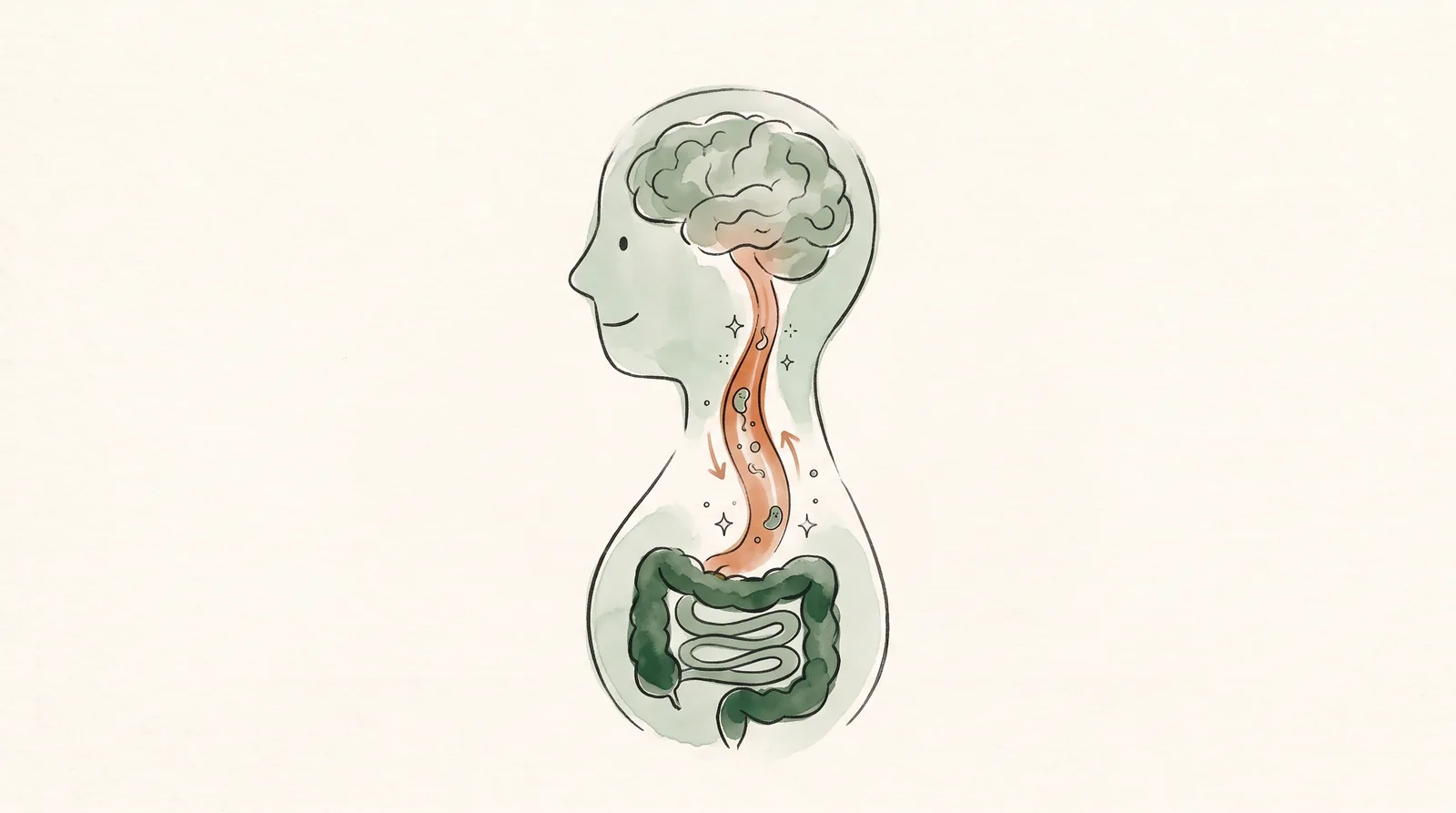
The gut-brain axis: What do we know about gut and mood?
"Your gut is your second brain." The headline keeps turning up in magazines and on packaging, and it is based on real research: the gut and the brain are connected, and the gut's bacteria are part of the conversation.
But it is a long way from an exciting link in a laboratory to being able to say that a supplement makes you happier. Here is what the research actually shows, and where it stops.
How do the gut and brain talk to each other?
Researchers point to several pathways [1]:
- The vagus nerve: a long nerve that connects the gut directly to the brainstem.
- The immune system: inflammatory substances from the gut can affect the rest of the body.
- Substances that the bacteria produce: for example short-chain fatty acids, when they ferment fibre.
The important caveat: most of this knowledge comes from experiments on mice, often mice with no gut bacteria at all [1]. They are good models for understanding mechanisms, but they are not humans.
The myth of the 90% serotonin
You may have read that over 90% of the body's serotonin is made in the gut. That is correct: around 95% of the body's serotonin is made outside the brain, mainly in the gut [2]. And gut bacteria can actually increase the gut cells' production of serotonin [3].
But serotonin cannot cross the blood-brain barrier [2]. The serotonin in the gut and the serotonin in the brain are two separate pools. Gut serotonin controls things such as the movements of the gut and the blood platelets [3], not your mood.
So the figure is true, but the conclusion "more gut serotonin = better mood" does not hold.
From mice to humans: when it does not hold up
The clearest example is the bacterium Lactobacillus rhamnosus JB-1.
- In mice it reduced anxiety-like behaviour and changed the brain's GABA receptors. The effect disappeared when the vagus nerve was cut [4].
- In 29 healthy men it did nothing. There was no effect on mood, anxiety, stress, sleep or memory compared with placebo [5].
The researchers themselves called their article "Lost in translation?". It is a good reminder that a promising mouse study is only the beginning.
What do the trials in humans show?
By now, many controlled trials of probiotics and mood have been carried out. Taken together, they show:
In people with diagnosed depression, meta-analyses find a small to moderate improvement in depressive symptoms, most often when probiotics are given on top of usual treatment, such as antidepressant medicine [6][7].
In healthy adults the effect is small. A meta-analysis of 12 trials with 3,350 healthy, working adults found a modest effect on symptoms of stress, anxiety and low mood. The authors themselves call the evidence preliminary [8].
The quality pulls things down. A large meta-analysis from 2026 of 70 trials found very different results from study to study, and the smallest trials showed the largest effects [9]. That is a classic sign that the positive results are overrepresented. A review of 30 other review articles judged that over three quarters of them were of moderate to very low quality [7].
It depends on the strain, and the results are mixed
Even for the most studied strains, the trials point in different directions:
- L. helveticus R0052 + B. longum R0175: A trial with 79 people with low mood found no difference from placebo [10]. A larger trial with 116 people with depression also found no overall difference, but a possible benefit in a subgroup [11].
- L. plantarum 299v: In patients with depression who were already taking antidepressant medicine, it improved attention and learning, but no effect on mood itself has been shown [12].
What about energy and "mental clarity"?
Here the evidence is very thin. We have not been able to find a single meta-analysis of probiotics for tiredness in healthy adults. Claims of more energy or sharper thinking do not have the research behind them.
Correlation is not causation
A large Belgian study with over 2,000 participants found that certain butyrate-producing bacteria (Faecalibacterium and Coprococcus) were linked to better quality of life, and that some of them were less common in people with depression [13].
That is exciting, but the study cannot say which comes first. Do the bacteria change mood, or does depression change diet, sleep and lifestyle, and with them the bacteria? Both are possible.
The bottom line
- The gut and the brain are connected, and gut bacteria play a role. It is a serious field of research.
- Most of the mechanisms have been shown in mice, not humans.
- In people with depression, probiotics appear to be able to give a small extra effect as an add-on to treatment. In healthy people the effect is small.
- No health claims for probiotics are approved in the EU.
The most solid route to a healthy gut flora is still a varied diet with plenty of fibre. See, for example, our article on prebiotics.
Supplements cannot replace treatment. If you have symptoms of depression or anxiety, talk to your doctor.
Sources
- Cryan JF et al. The Microbiota-Gut-Brain Axis. Physiol Rev. 2019. PMID 31460832
- El-Merahbi R et al. The roles of peripheral serotonin in metabolic homeostasis. FEBS Lett. 2015. PMID 26070423
- Yano JM et al. Indigenous bacteria from the gut microbiota regulate host serotonin biosynthesis. Cell. 2015. PMID 25860609
- Bravo JA et al. Ingestion of Lactobacillus strain regulates emotional behavior and central GABA receptor expression in a mouse via the vagus nerve. Proc Natl Acad Sci U S A. 2011. PMID 21876150
- Kelly JR et al. Lost in translation? The potential psychobiotic Lactobacillus rhamnosus (JB-1) fails to modulate stress or cognitive performance in healthy male subjects. Brain Behav Immun. 2016. PMID 27865949
- Asad A et al. Effects of Prebiotics and Probiotics on Symptoms of Depression and Anxiety in Clinically Diagnosed Samples. Nutr Rev. 2025. PMID 39731509
- Sá Filho AS et al. "Attacking" the Gut-Brain Axis with Psychobiotics: An Umbrella Review of Depressive and Anxiety Symptoms. Pharmaceuticals (Basel). 2026. PMID 41599756
- Ben Fredj S et al. Probiotic intake and mental health in healthy working adults. BMC Psychol. 2026. PMID 41501907
- Lian J et al. Pre-/pro and synbiotics on anxiety and depression symptoms: a GRADE assessed systematic review and meta-analysis. Ann Gen Psychiatry. 2026. PMID 42010690
- Romijn AR et al. A double-blind, randomized, placebo-controlled trial of Lactobacillus helveticus and Bifidobacterium longum for the symptoms of depression. Aust N Z J Psychiatry. 2017. PMID 28068788
- Gawlik-Kotelnicka O et al. Metabolic Status Influences Probiotic Efficacy for Depression – PRO-DEMET Randomized Clinical Trial Results. Nutrients. 2024. PMID 38732635
- Rudzki L et al. Probiotic Lactobacillus Plantarum 299v decreases kynurenine concentration and improves cognitive functions in patients with major depression. Psychoneuroendocrinology. 2018. PMID 30388595
- Valles-Colomer M et al. The neuroactive potential of the human gut microbiota in quality of life and depression. Nat Microbiol. 2019. PMID 30718848
This article is general information and not medical advice.